
By Councillor Charles Jago
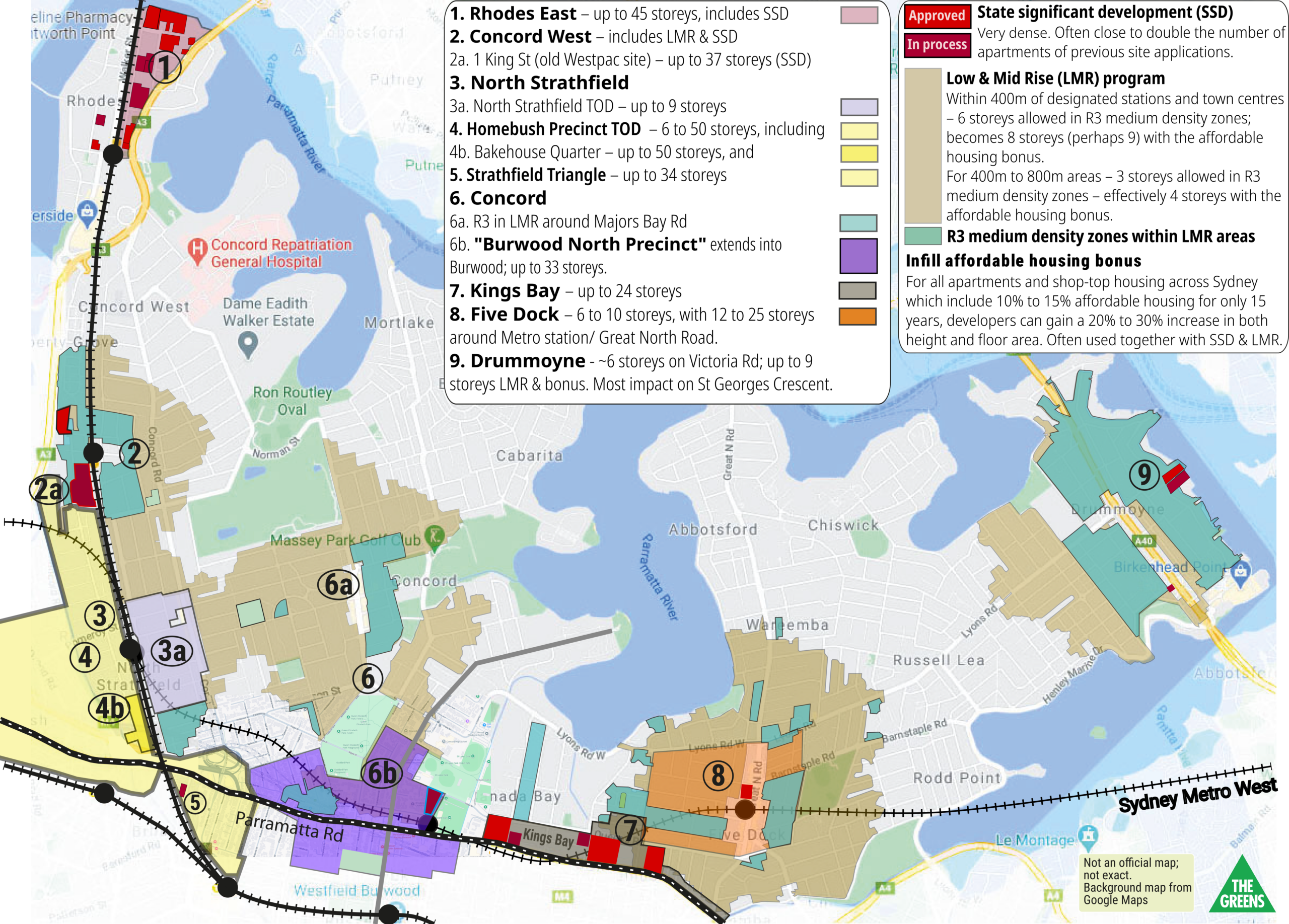
How LMR works
DPHI released the Changes to create low and mid-rise housing with an “explanation of intended effect” (EIE) document in mid-December 2023 for land within:
- 800m walking distance of heavy rail, light rail or metro stations;
- 800m walking distance of land zoned E2 Commercial Centre; and
- 800m walking distance of land zoned E1 Local Centre or MU1 Mixed Use, but only if the zone contains a wide range of frequently needed goods and services, such as full-line supermarkets, shops and restaurants.
These changes are far-reaching across Canada Bay LGA. The new rules apply to a large proportion of Canada Bay LGA, with the LMR program having widespread effect across Canada Bay, and particularly in Concord West, Concord, Five Dock and Drummoyne.
Unlike the TOD program, the changes vary with current zoning. The first stage permitted dual occupancies and semi-detached homes in all R2 low-density residential zones across NSW. The NSW Government also wants to allow multi dwelling housing in low density residential zones (R2) within station and town centre precincts – this includes townhouses, terraces and manor houses, in addition to dual occupancies which are already allowed. The government has created “non-refusal standards” for all of these with larger heights and floor space ratios and smaller site width and site area requirements than currently exist. These buildings will be inappropriately sized for the area, but council won’t be able to stop it.
Where medium-rise zoning (R3 Medium Density Residential) is already in place, the proposed changes will allow 6-storey apartments within 400m of stations or centres, and 4-storey apartments for areas from 400m to 800m of these locations. The changes will also allow “shop top housing” (one or more dwellings located above a ground floor commercial premises or health services facility).
In addition, the Infill Affordability Housing Bonus [add link] provides a large additional incentives potentially available to developers for affordable housing with extra building height and floor area. However, affordable housing has been diluted to only last for 15 years.
Unintended consequences
With these changes to housing around many residential centres, the government is making changes to an area far larger than necessary to meet their housing goals. With the substantial height increases the government is requiring, they could have limited the changes to a smaller area and still achieved a huge number of additional dwellings. The broad geographical extent of the planning rules means that the majority of established suburbs across Canada Bay LGA will be irrevocably altered over time.
LMR expands the options for developers so much that they can pick and choose their options with a huge range of choice. Right now, Drummoyne – and specifically St Georges Terrace – is getting a lot of new Development Applications. You can understand why, given that new developments there will have panoramic river views. However, very little development is happening in the two Transport Oriented Development (TOD) precincts of Homebush and North Strathfield. So much for the government’s objective to put new development close to railway stations. Meanwhile, St Georges Crescent is heading toward massive traffic and planning problems from this ill-planned LMR program.
See the council’s responses to the “Changes to create low and mid-rise housing” program and the related new “Housing SEPP” (SEPP – State Environmental Planning Policy).
Of course, as for all the government’s programs, they are not providing the infrastructure: schools, transport upgrades and more that the community needs [add links], not to mention that the population will more or less double over the next 20 years or so.